Hangul — invented in 1443, lost, found in a coat

King Sejong personally invented the Korean alphabet in 1443. Its instruction manual was lost for four centuries, then carried through the Korean War inside a man’s coat.
Hangul is unusual among writing systems in having a known author, a known date, and a documented rationale. King Sejong of Joseon invented it in 1443 — Sejong year 25, lunar 12 月. Twenty-eight letters: seventeen consonants drawn from the shape of the speech organs that produce them, and eleven vowels modelled on the philosophical triad of Heaven (ㆍ), Earth (ㅡ), and Human (ㅣ).
It was promulgated in 1446 as 훈민정음 Hunminjeongeum — “the proper sounds for the instruction of the people.” The same year, the Hall of Worthies scholars produced the Haerye, an explanatory volume that argued, against considerable literati resistance, why the country needed an alphabet at all.
“The speech of our country differs from that of China and does not link with the Chinese characters…” — Sejong, preface to Hunminjeongeum
The literati won the political argument for centuries. Hangul was treated as a script for women, children, and Buddhist texts — not the official register. The Haerye was lost around the early 1500s.
It was rediscovered in 1940 in Andong by collector Jeon Hyeong-pil (Gansong). The seller asked 1,000 won. Gansong paid 10,000 — the price of ten houses — on the grounds that the manuscript was worth more than the seller knew. During the Korean War, as Gansong evacuated south, he carried the Haerye inside his coat.
The manuscript is now National Treasure No. 70 (1962) and a UNESCO Memory of the World (1997).
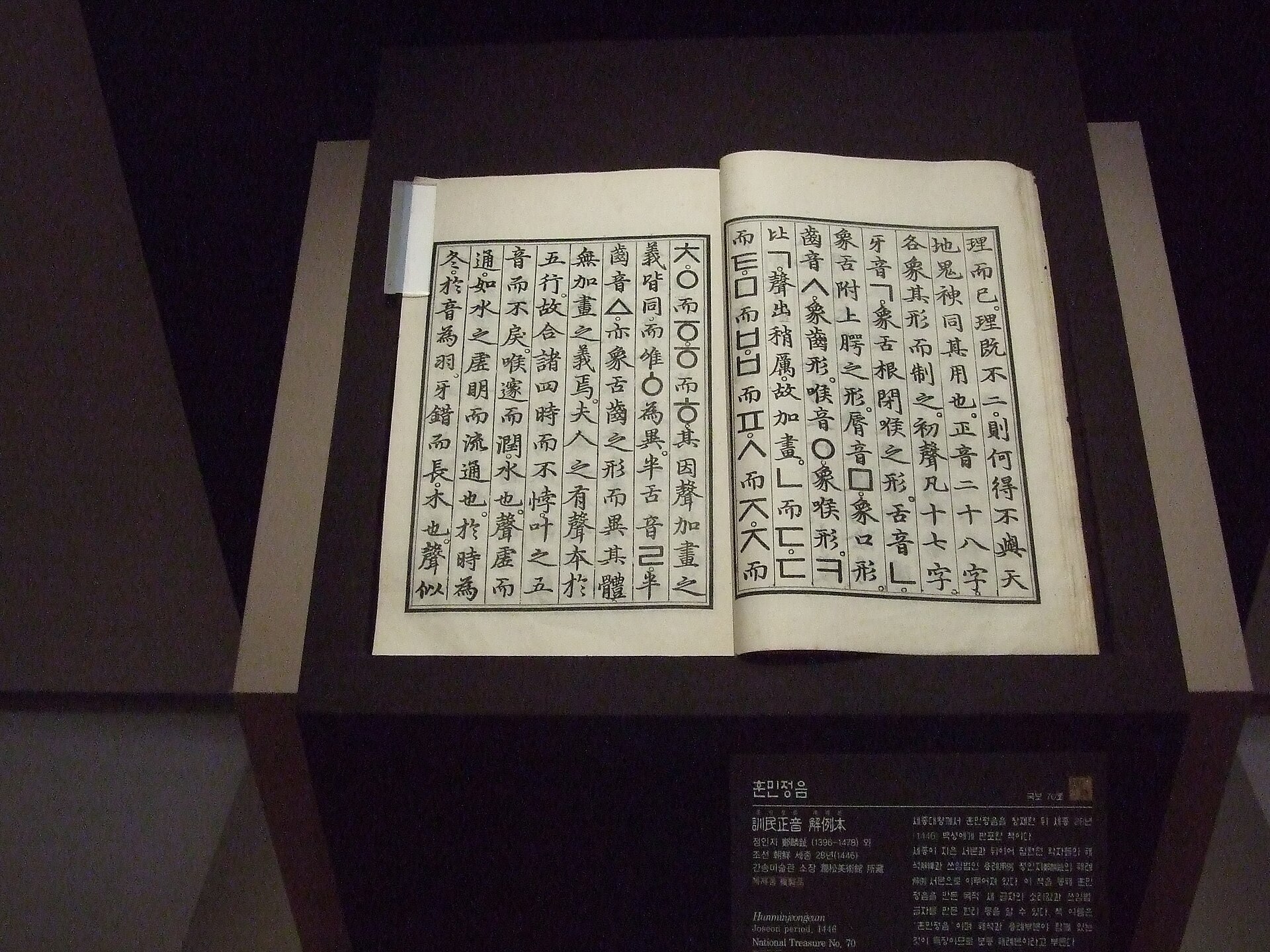
For typography, the importance is specific. Hangul is the only major writing system whose articulatory logic is documented by its inventor. You can read why ㄱ is shaped the way it is — it is a side view of the back of the tongue against the soft palate. ㄴ is the tongue tip at the alveolar ridge. ㅁ is the shape of closed lips. No Latin letter has its design rationale on record in this way.
If you are designing Hangul fonts in FontLab today, as Kwon Gun-oh’s 2025 Korean guide explains in detail, you are working with a system whose geometric logic was set down in 1443 and has never needed to be re-argued. That is a strange and rather useful position to be in.