Warhol's August 1962 silkscreen pivot
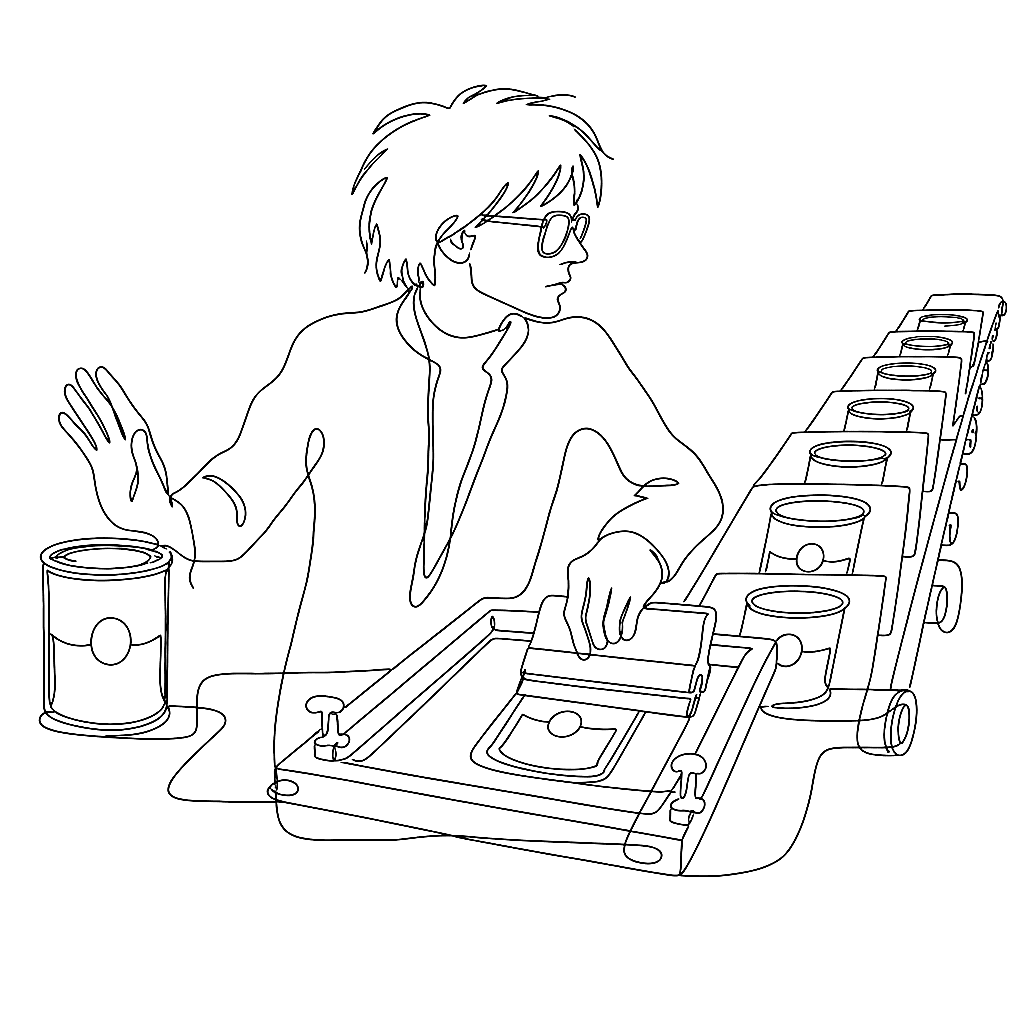
Andy Warhol started screenprinting in August 1962. His explanation: “I wanted something stronger that gave more of an assembly line effect.”
The explanation is a little too clean, which makes it probably true. Warhol had been making paintings — hand-painted Campbell’s Soup cans, hand-traced comic panels — and the hand was getting in the way. Silkscreen removed it. The image went through a mesh and arrived on the canvas without fingers.
Within weeks of Marilyn Monroe’s death that August, he produced the Marilyn Diptych: fifty images of Monroe arranged in a grid, all derived from a single 1953 Gene Kornman publicity still for Niagara. Half in colour, half in fading black and white — the colour half vivid and off-register, the black-and-white half going pale. The 1967 portfolio used Day-Glo fluorescent inks on ten 36 × 36-inch screens in an edition of 250.
Shot Sage Blue Marilyn sold at Christie’s in May 2022 for $195 million.
What’s worth holding from a print-making angle is that Warhol’s silkscreen is a technology of registration error. Each colour is a separate pass through a separate screen. Each pass lands slightly off. The slip is not a defect he tolerated; it is a texture he kept. The eye reads four screens that don’t quite line up and assembles a face from the difference.
Newspaper halftones had the same property by accident — the CMYK screens drifted a little at press speed and the image acquired a visible grain. Warhol made the drift intentional. Once it was intentional, it was available to everyone as a method rather than a mistake.
All Warhol images remain © Andy Warhol Foundation/ARS. The Tate’s Marilyn Diptych page (linked below) is the canonical public reference — do not reproduce the works.